Tuesday, June 19, 2012

Years Of Heartwork@memories.PhuketThailand


soo...u think u can dance..eh!..BMW ECO PRO.


Fancy having the same Auto Start/Stop function you can find in all new BMWs in your Windows or Mac computers? Well, read on.
BMW Group Malaysia has just released the BMW Eco Pro screensaver that works on the same principle as the Auto Start/Stop function. It works through facial detection on computers fitted with webcams. Move away from your computer for 10 seconds and the screensaver would switch off the screen. Come back and your computer will get back to business.
BMW says that you’ll be able to reduce the average energy consumption of an idling laptop by 693.99 watts, which is an 89.87% reduction from the default energy settings in spite of the additional use of a webcam. It all adds up – over 12 million kW saved if every computer in Malaysia goes idle for 10 minutes. Or 200 kW on a global scale.
BMW’s initial projections also estimates the move would reduce up to 36 tons worth of CO2 emissions. And enjoy a worldwide financial savings of up to RM145 million through a better use of electricity.

CEO Protons Classy SwanSong!Preeve TURBO!


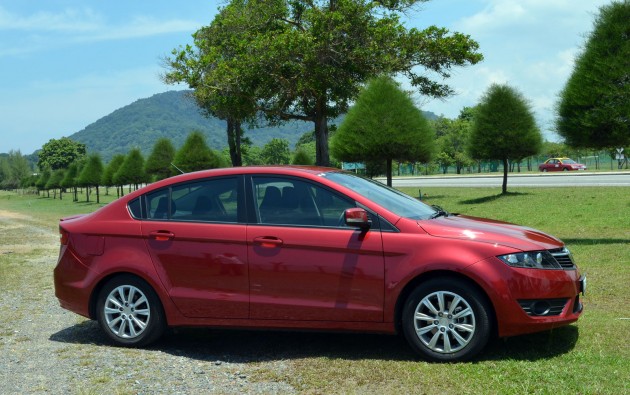
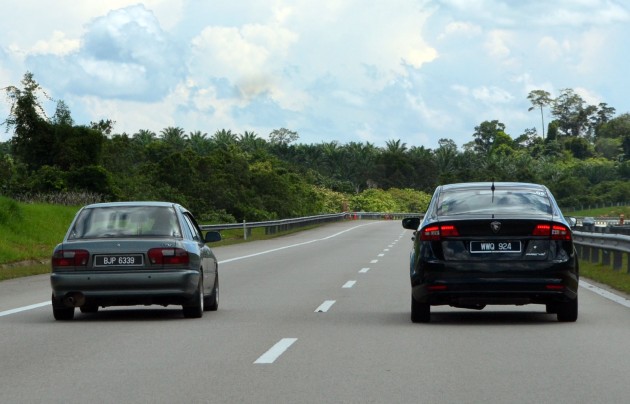
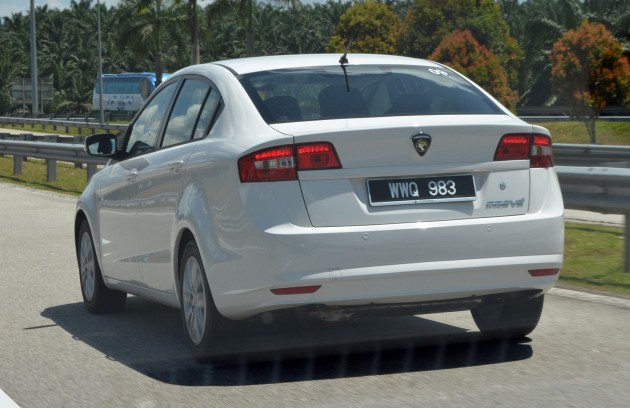
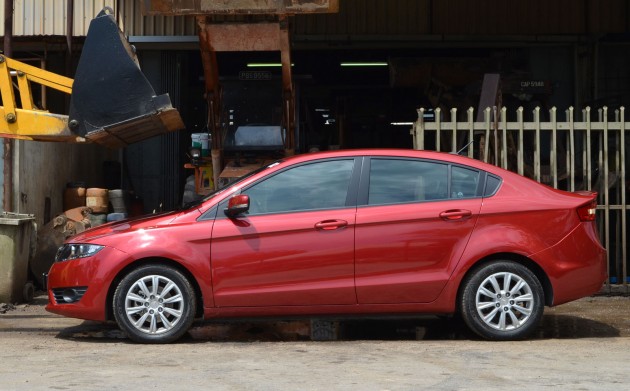
I’ve had a go at the Proton Prevé, finally. After hearing so much about it from my colleagues (raves and rants, but more of the former) who attended the preview drive, and seeing the latest Proton in the metal at the launch, a drive event to Cherating in THE car of the moment was not to be missed!
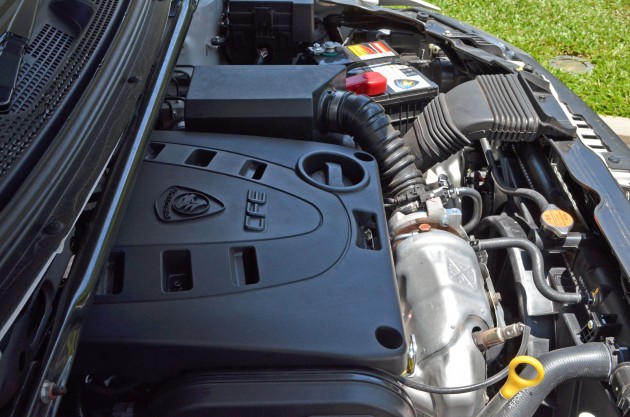
The media drive was divided into two groups, and I drove the Prevé on the return leg from the East Coast to KL. Two variants out of three were brought to the event – the range-topping Preve 1.6 CFE (turbo engine and CVT gearbox) and the entry level 1.6 Manual, powered by the Campro IAFM+ engine.
Continue reading after the jump.
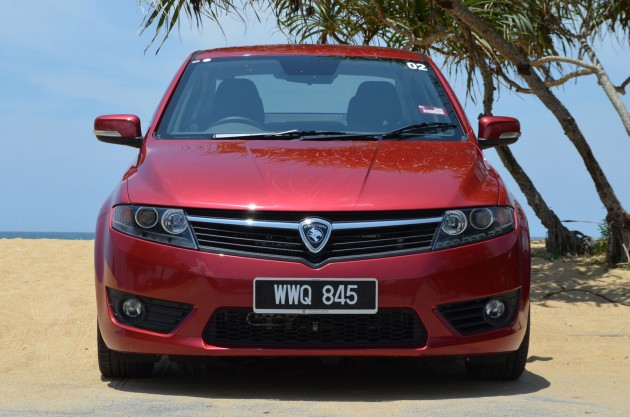
No need to go all technical – after months of teasing, a detailed launch report and drive impressions from two testers, I believe you already know what you need to know, technically.
To briefly recap, the C-segment Prevé is available in three variants – the 1.6 CVT Premium, the 1.6 Executive CVT and 1.6 Executive Manual. The Premium CVT is powered by a turbocharged CFE engine with 138 hp and 205 Nm, while the Executive models come with the naturally-aspirated CamPro IAFM+ engine with 107 hp and 150 Nm.
The turbocharged range-topper does 0-100 km/h in 9.6 seconds and has a top speed of 190 km/h. The cheapest manual variant manages 0-100 in 12 seconds and 180 km/h. The IAFM+ CVT combo is the slowest with 12.5 seconds and 170 km/h.
The most-booked variant so far is the Premium, by a huge margin. In contrast, the stick-shift Prevé is stuck in single digits, percentage wise.
We started the day driving the 1.6 Manual on twisty trunk roads, before upgrading to the Turbo CVT, a good sequence. The base stick-shift Prevé is slow as expected, with acceleration found wanting. This is evident when pulling off from low speeds and when momentum is broken.
Maintaining momentum is key in this variant, and the peaky engine needs to be worked hard in any case. More low to mid-end torque would definitely be welcome.
That said, bear in mind that media drives often involve all-out driving and fast convoys. We were also “chasing” the lead group in the Turbo (and even managed to hang on to some poorly driven examples), so the lack of grunt, especially at the low end, was amplified. The M/T Prevé is slow in context, but is usable in normal driving.
A car is so much more than “power” though, and the Prevé fares very well in other driving aspects. Especially nice is the balance between ride comfort and handling, as well as subjective things such as the feel of the controls.
What stands out the most for me is ride comfort and damping, which is unrivaled in the Asian C-segment sedan class. Many will say “Continental feel,” but I can think of some Euro hatches that could do with this level of composure. It makes bad roads feel good, the Prevé.
This unflappable feel extends to the road holding. Hit a dip or bump mid corner and you’ll know what we mean. The Proton sticks to its line, doesn’t gets thrown off course and the rear end doesn’t hop across horizontal obstacles.
This, combined with the natural feel of the steering and brake pedal, means that Prevé is a car that inspires confidence when driven fast – you always know what the car is doing, and can gauge how much it has in reserve. Not easy to measure, or explain for that matter, but I rather this than plenty of cold hard grip without the confidence.
Since this is a family car, the suspension is on the soft side of the scale, so there’s some roll in tighter bends, but nothing off-putting or too dramatic. The observations above were gleaned from fast country road driving – short customer test drives around the block will reveal a “comfortable” and “easy to drive” car, which is accurate.
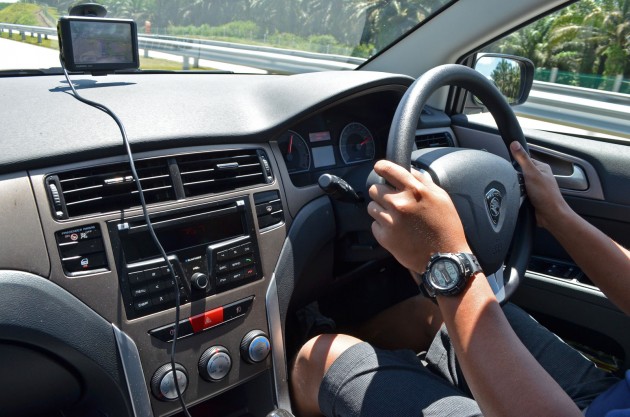
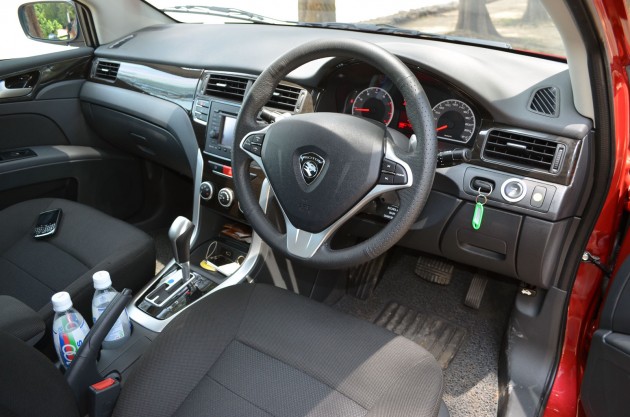
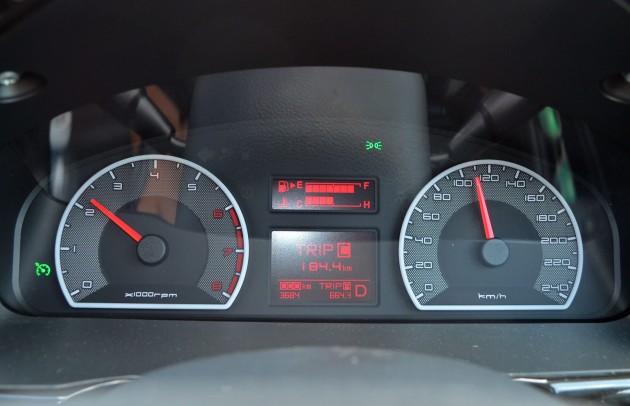
What didn’t I like? The instrument panel. The fonts are too flat and stylised for me – difficult to read at a glance. If Proton was trying to achieve a “sporty” feel, they should note that Audi dials, and even those in the Lancer/Inspira, look good and are very legible. Jogging through the multi-info display, I noticed that the “TRIP A” font size is larger than the km reading, when it should be the other way round.
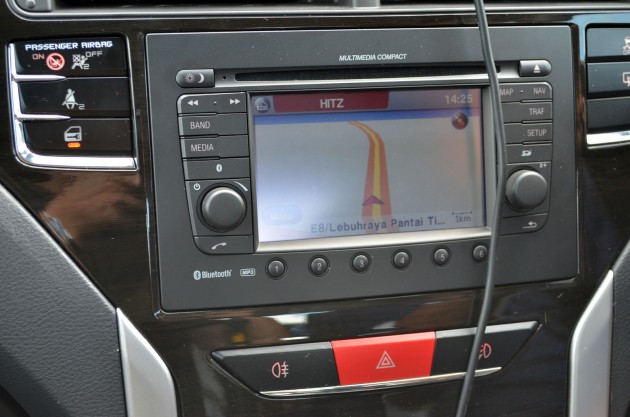
More on the interior. The Turbo comes with a head unit complete with sat-nav, and while this is a good addition, it’s could be better designed. It’s not efficient use of space when the border is so wide, and the screen so small. They could have easily put a bigger screen and just two vertical strips of buttons/dials, VW style, but I’m told that this is an off-the-shelf head unit, and not a clean sheet design.
I’m also not too keen on the gold-ish trim colour in the M/T, preferring the dark wood of the Turbo. No complaints on the ergonomics, though. Everything is on hand and the driving position is good.
Moving on, the 1.6 CVT Premium is a much faster car, obviously. But fast is not the first impression I get, and it’s most probably due to the stepless gearbox. I may not be a fan of CVT, but I recognise that this type of transmission – chosen here for both cost and fuel economy – can be painless and relaxing when done right. Nissan does CVTs well, and the Sylphy is a great example of how the ‘box can add to the driving experience.
Acceleration in the Turbo feels labourious. The key word here is “feels,” because a glance at the speedo needle shows that we’re making good progress. Initial lag, a low-rpm drone and a faint whine throughout means that the Punch CVT isn’t the most “regular automatic-like” CVT in the market. The manual mode feels artificial as well, and the steering paddles work with toy-like tactility.
The 1.6 CFE could be a great engine, but we’ll only get to know it better with a proper manual gearbox or a regular torque converter automatic. The latter is unlikely, because a five- or six-speed unit is costly, and Proton has already gone well down the CVT route.
I reached KL with mixed feelings. The Prevé is a good car to drive and live with (decent looks, lots of space, good NVH), and it has a great package of comfort, handling and feel. Many will be well served by Proton’s latest, I’m sure, but there’s not one variant that’s “just nice” for Mr. Picky here.
The CFE has the kit list, nicer cabin and pace, but its CVT isn’t on par with the best out there. The entry-level manual, on the other hand, has the correct gearbox (I own two manual cars) but lacks pace. I didn’t get to try the CVT/IAFM+ combo, but Anthony and Chris told me not to bother!
So my ideal Prevé doesn’t exist yet – as you can probably guess by now, it’s a 1.6 CFE Manual!

and then..there were CARS!


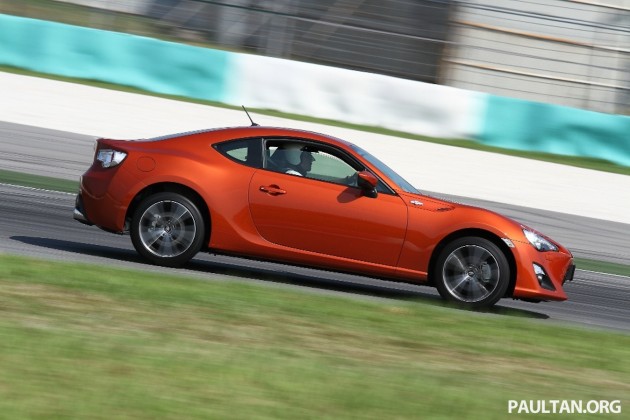
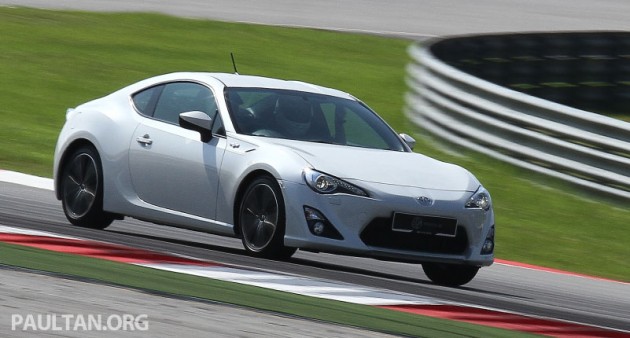
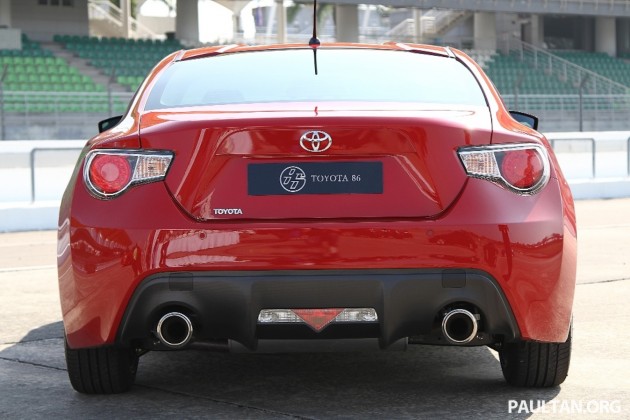
UMW Toyota has officially launched in Malaysia one of the most anticipated sports cars in recent times, theToyota 86. Known simply as the 86 here, as opposed to “GT86″ for Europe and “FT86″ for the concept, the car is a spiritual successor to the original AE86 hachi roku, the rear-wheel drive Corolla coupe of the 80s, made popular by drifting and Initial D.
Toyota says that two other iconic sports cars influenced the 86′s DNA – the tiny Sports 800 (FR layout, boxer engine) and the curvy 2000GT, which served as a starting point for the stylists. If you don’t already know, the 86 was co-developed with Subaru, which sells its twin sister the BRZ.
As mentioned in our BRZ test drive report, Toyota was in charge of the car’s styling and product planning, while Subaru handled engineering and production. The 2.0 litre four-cylinder boxer engine is Subaru’s trademark, enhanced with Toyota’s D-4S direct fuel injection system and VVT. The boxer engine is relatively compact and flat, with a low centre of gravity, which makes it very suitable for a sports car.
With a high 12.5:1 compression ratio, the 16-valve DOHC flat-four engine makes 200 PS at 7,000 rpm and 205 Nm of torque available between 6,400 and 6,600 rpm. Redline is 7,450 rpm. Two gearboxes are available, a six-speed manual or a torque converter automatic with the same amount of forward ratios. The self shifter comes with steering paddles, sequential shift and Sport Mode.
Power is sent to the rear wheels via a Torsen limited slip differential (LSD) and front-rear weight distribution is 53:47. The VSC system has a Sport mode that is less restraining, but the electronic nannies can be completely switched off for some sideways fun, an essential part of the 86 experience.
Should things go wrong, seven airbags are standard (front, side, curtain, driver’s knee), as are ABS, EBD, Brake Assist, and VSC. ISOFIX mounts are included in the rear. With today’s crash and safety requirements, the 86 won’t be sub-1000 kg, but a kerb weight of 1,275 kg (1,298 kg for auto) is light for today’s standards. An aluminum bonnet and resin fuel tank, help the cause, among other things.
The suspension consists of front MacPherson struts and double wishbones for the rear. The steering is of the electric (EPS) variety with a “sporty” 13:1 ratio. Ventilated disc brakes can be found at all corners, along with 17-inch alloys and 215/45 Michelin Primacy HP tyres.
Eagle eyes out there will notice the smaller centre cap on the wheels – 49 mm vs the usual 60 mm. Apparently, this saves weight without any loss of rigidity, and makes the spokes appear longer, giving the illusion of bigger wheels.
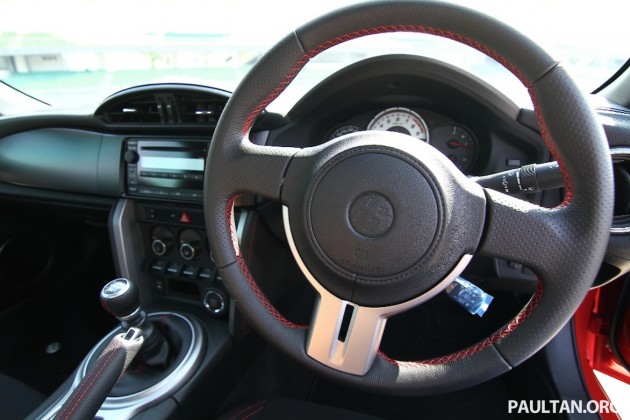
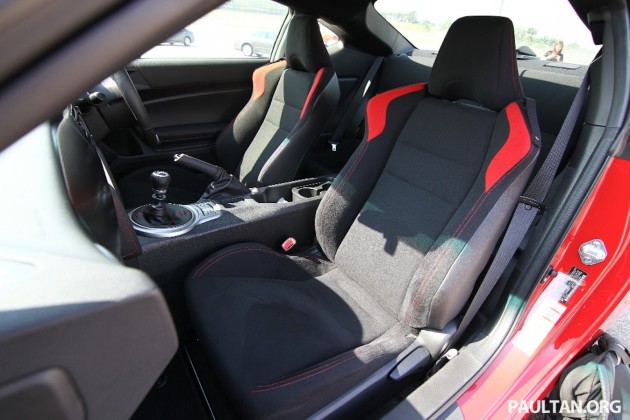
The cabin features semi-bucket seats and a small diameter three-spoke wheel – at 365 mm, the 86 wheel is the smallest in any Toyota. There’s also a programmable shift indicator – 100 rpm increments from 2,000 to 7,400 rpm. Standard kit includes smart entry/start, a 2DIN audio system with six speakers (CD, AUX, USB) and auto air con.
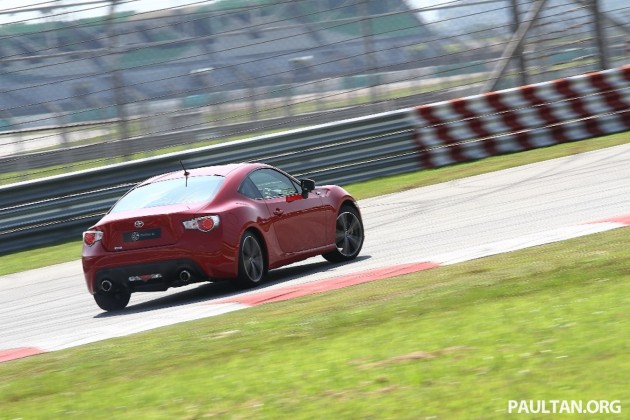
We were given a very limited and brief sample of the 86 at Sepang (South Track, automatic version only, VSC on) and the 86 shows plenty of promise as a car that will delight the enthusiast.
The seating position is very low and all controls are perfectly placed, including the auto shift stick that mimics the design of a manual. The engine is enthusiastic and smooth revving, and although there’s no turbo style kick in the back, one gets the joy of a pushing a high-revving naturally aspirated engine to the max – an extremely rare pleasure these days.
There’s a relatively loud tone when the engine is extended, which is welcome, although I can’t quite extract “boxer notes” from the overall tune. The weight and feel of the steering and brakes are spot on, and the lightweight, agile feel of the 86 is apparent throughout.
Push hard and the tail will ease out, but with the VSC on standby, we couldn’t get the 86 to do what it’s famous for. Just a bit of rear end slip before we were brought in line again. Whatever drifting you see here was done by no other than Tetsuya Tada, chief engineer of the 86. It was quite painful to see the “demo session” done on a manual 86 and hear the tyres howl away – classic example of can see, cannot touch!
For more, read our first impressions of the Subaru BRZ. Not being lazy here, because both cars feel exactly the same in the limited wheel time I had.
Six colours are available, and they are Satin White Pearl, Crystal Black Silica, Sterling Silver Metallic, Lightning Red, Galaxy Blue Silica and Orange Metallic. The latter is an 86 exclusive colour, much like whatWR Blue Mica is to the Subaru BRZ. Satin White Pearl is an RM800 premium.
The selling price is RM243,000 for the manual and RM249,000 for the automatic, as per initial estimates. 30 orders have been placed. As with all cars sold by UMW Toyota Motor, the 86 comes with a three-year or 100,000 km warranty, something one will never get from grey importers. The full spec sheet by UMWT has been online for quite some time – click here to see it.
Speaking of them, we won’t be expecting to see many grey units around – Toyota and Subaru can’t make enough of the 86/BRZ twins despite full throttle production and demand is clearly outstripping supply.
Ready, get set, go ahead and feast on the gallery below!

Preves Selling!~


Proton announced that the Prevé has received 11,310 bookings in two months after its launch, making it the most popular 1.6 litre sedan in the market. Decent figures, although the “most popular” tag is academic, given the lack of 1.6 litre sedan rivals with national car status.

Of the 11,310 names, almost 1,000 were collected as early as March, while another 4,893 units were booked in the month of April. The Prevé can be had in three variants – 1.6 CFE turbocharged engine with CVT, IAFM+ with CVT or the same NA engine with a five-speed manual transmission. They cost RM72,990, RM62,990 and RM59,990 respectively.


“With more than 10,000 Prevé booked to date, and with the numbers increasing every day, it has quickly established itself as the consumer’s preferred choice of compact sedan. This is a very positive sign for us and further proof that Proton can engineer and manufacture world class products,” said Proton Holdings Berhad Executive Chairman, Datuk Seri Mohd Khamil Jamil.

“It was a vehicle that was eagerly anticipated by the market and continues to be well received, not only because it is affordable and offers owners a low cost of ownership, but excels in the terms of styling, performance, safety and equipment level,” he added.


Tuesday, May 8, 2012

Prinsip Dinamika Pekerja..

Kehebatan Otak Manusia...Setiap sel otak mempunyai kapasiti seperti satu komputer besar ..yang mampu menampung paling minima 300 kemahiran..

Membina dan mengekalkan fikiran positif...tukar fokus..fokus kepada yang positif...senantiasa cari emas...jangan bertangguh tangguh...bentuk sikap bersyukur dan berterima kasih...jauhi pengaruh negatif...

Perubahan secara emosi...lakukan setiap kegiatan dengan bersemangat...Mesti ceria setiap masa..Mesti ada passion...hindari stress...sonyum sokmo!

Perubahan secara Sosial..Senantiasa cari kawan yang baru...tingkatkan hubungan di tempat berkerja..tingkatkan hubungan di rumah...tingkatkan hubungan dalam masyarakat...

Perubahan secara rohani...Solat..Zikir...Istighfar...Membaca Al quran...Belajar Agama..Belajar al Quran..Amar Makruf..Menghidupkan sunah sunah harian...Bersedekah...Puasa Sunat...

Prinsip
Lebih Ilmu dari orang lamin dan terus belajar..
Lebih tekun komited berbanding orang lain
Lebih sanggup berkorban
Lebih global berjiwa besar
Lebih besar jaringan sahabat
Lebih solat dan berdoa
Lebih banyak memberi dengan ikhlas
Lebih pemaaf memohon maaf satun hati
Lebih kreatif ..banyakkan berfikir luar otak..
Lebih redha dan bersyukur..
Lebih seimbang dan laukan yang terbaik..
Lebih berdikari dan sifat kepunyaan yang tinggi
Lebih professional dan ada semangat untuk terus wujud!

9 AT: niat,lihat,ingat,semangat,buat,dapat,berkat,hakikat,tabiat...awat!???haha

Perubahan Secara Mental....

*Selagi kita takut untuk membuat sesuatu yang luar biasa...sekagi itulah kita terperangkap dalam zon selesa  yang di belenggui kegagalan..
*Untuk mendapatkan hasil yang luarbiasa,usahalah secara LUARBIASA..
*Seseorang yang mempunyai 2 hari yang tidak berbeza ...pasti akan menemui kegagalan...apatah lagi 16 bulan..HAHA!..
*Ubah kaedah bertidak..Ubah amalan Harian..Ubahlah cra berdoa..Ubah kan rutin yang asik menemui krgagalan..dan yamg penting..BERSEDIA INTUK BEKERJA DENGAN BERSUNGGUH SUNGGUH..
*Tiada perubahan yang tidak penting..walaupun sebesar zahrah!
*Kita tidaj akan mengubah kehidupan klita sehingga kita mengubah keterbiasaan kita..
Jika kita buat perubahan yang mudah..yang kecil setiap hari...dan jika kita istiqamah memajukan diri kita setiap hari..past kita dapat mengubah kualiti kehidupan kita dengan cemerlangnya...
*Programkan Perubahan Dalam Minda:
Gambarkan sebelum tidur,Tulisdan lihat selalu,sebut selalu,doa

Pekerja Cemerlang Sentiasa mencari dan peka kepada titik perubahan..

Titik Perubahan..
baca buku,dengar kaset,suasana baru,ilham dari allah,mendapat musibah,pengetahuan baru,pengalaman baru,di nasihat,di biarkan,di rangsang,si kaunselling,hadir kursus HJ HANIM??wakakaka..
*Seimbangkan perubahan mental,Emosi,Fizikal,Sosial dan Rohani...